The Suit Doesn't Come Off: Non-League Football's Unpaid Mascot Economy
There is a particular smell that hits you when a non-league club opens the cupboard under the stairs at the back of the clubhouse. It is part old chips, part damp polyester, part the ghost of a hundred Saturday afternoons. It is the smell of the mascot suit.
The cupboard smell of commitment
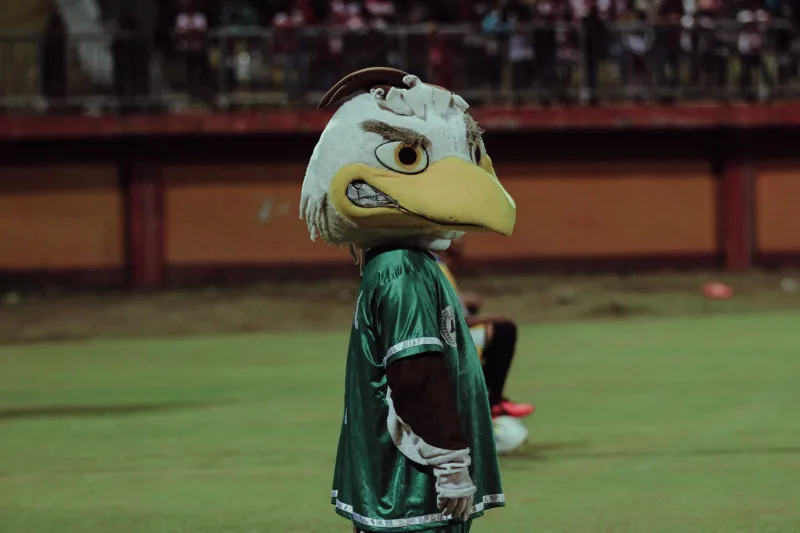
Every club at step three and below has one. Sometimes it is a proper costume, ordered from a catalogue by a chairman who thought it would be nice for the kids. More often it is a homemade head, stitched together by a committee member's sister, with eyes that sit slightly too far apart and a mouth that has never quite closed. The suit is not a gimmick. It is an audit.
You can tell a lot about a non-league club by the state of its mascot. A club with a clean, well-padded suit and a rota of volunteers is a club with a future. A club with a head that has been Sellotaped at the seams and a single teenager sweating through the fourth consecutive home game is a club running on goodwill and not much else. And a club with no mascot at all? That is a club that has quietly given up on the idea that anyone under twelve might come back next week.
A job advert nobody writes
Nobody applies to be a mascot. It happens by accident. You are fifteen, you have been coming to the ground with your dad since you were six, and the club secretary catches you in the tea hatch one Tuesday night. 'You'd fit in the dog,' she says. That is the interview. That is the contract.
The pay is nothing. The hours are matchday plus twenty minutes either side for changing and, crucially, for the slow walk across the car park while children point and adults pretend not to look. The perks are a free programme, a can of Coke, and the strange social capital of being the only person at the ground who is allowed to dance badly on the touchline without anyone asking questions.
Heat, headaches and the pitch invasion protocol
Here is what nobody tells you about the suit: it is a greenhouse. Even in November, a full ninety minutes inside a furry head is a cardiovascular event. In August it is dangerous. Clubs have learned to keep water bottles in the tunnel and to send a steward over if the mascot stops moving. The unwritten rule is simple: if the mascot sits down, something is wrong.
Then there is the pitch invasion question. Non-league football has a long and proud tradition of children running onto the pitch at full-time, and the mascot is expected to absorb them. A good mascot will high-five the first wave, pose for a photo with the second, and gently shepherd the third back towards the stand. A bad mascot — or a tired one — will stand rigid near the dugout while a seven-year-old headbutts them in the knee.
There are other rules. Never take the head off in front of the kids. Never speak. Never admit, even when a drunk bloke in a flat cap asks you three times, that you are 'just Dave from the under-14s'. The fiction matters more than the heat.
Inheritance, retirement and the missing head
The strangest part of the mascot economy is what happens when the suit changes hands. Costumes are handed down like relics. A club in the Northern Premier League has a lion head that has been worn by two generations of the same family. The original wearer is now the club's vice-chairman. His daughter does the away days. The head has been re-stuffed twice and still smells of 2009.
Retirement is rarely official. A mascot does not resign; they simply stop turning up. The suit goes back in the cupboard. Someone says they will sort it out in pre-season. Nobody does. By October the head has been borrowed for a school fete, returned with a jam stain, and quietly retired to a shelf above the boiler.
And then there is the missing head. Every club has a story about a mascot head that vanished. It went in a minibus. It was left at an away ground. It was last seen being carried across a retail park by a bloke in a Stoke shirt. The head never comes back. The club survives. The kids survive. But something is lost.
What the suit says about the club
The mascot is not the most important person at a non-league ground. That is the treasurer, the tea lady, the referee, the under-16s goalkeeper who has turned up despite a dead leg. But the mascot is the most honest. They are the club's sense of humour made physical. They are the proof that this is still a place where a teenager in a furry hat can run along the touchline and make a toddler laugh.
So next time you see a mascot sweating through a November drizzle, do not just smile and walk past. Look at the stitches. Look at the shoes — usually trainers, because clubs cannot afford the proper feet. Look at the volunteer inside, because there is always a volunteer inside. The suit is a barometer. If it is still being worn, the club is still breathing.