The Eight-Minute Window: Why the Clubhouse Queue Is Non-League's Truest Team Sheet
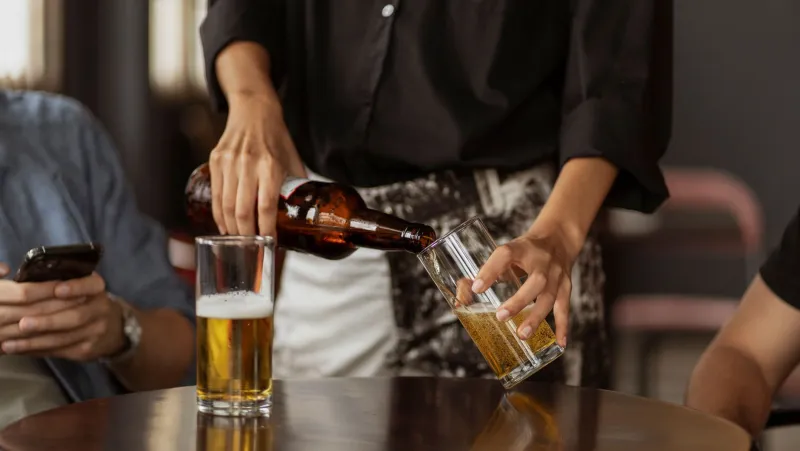
At 3:47pm on a damp November Saturday, the referee's whistle does not simply end the first half. It fires a starting pistol. Somewhere behind the stand, a volunteer with a dish towel over one shoulder hears it and braces. The hatch slides open. The queue begins. Welcome to non-league football's most fragile social contract: the half-time pint rush.
The whistle is the starting gun
There is a version of non-league matchday that exists in glossy programmes: founding members, floodlight funds, a chairman's note about the community. Then there is the version that exists in the clubhouse at 3:48pm, where a bloke in a fleece is trying to pour four bitters, find the card reader and answer a question about whether the tea urn is on. The second version is more honest.
The half-time queue is not really about beer. It is about time, trust and the unwritten agreement that nobody will order a round of eight complicated drinks with four minutes left. Eight minutes sounds generous until you are standing behind someone who wants a Guinness, a lime and soda, two packets of crisps and a receipt. The queue has its own arithmetic. It rarely balances.
The pourers are the real midfield
Behind the bar, the volunteer is the engine room. They know which pump is bitter and which is lager, even when the labels have been rubbed off. They know the fridge door sticks. They know the card machine needs a firm look before it works. They know that the away fan in the scarf is not a threat, just thirsty and slightly lost.
A good pourer can move a queue like a good midfielder can switch play: quickly, calmly, with a minimum of fuss. A great pourer can do it while answering questions about the 50/50 draw, directing someone to the toilets and pretending not to notice the committee member who has definitely jumped the queue. That is not customer service. That is community diplomacy.
Queue geography and the regulars' map
Every clubhouse has a map, and it is not on the wall. Regulars know which end of the bar moves fastest. They know the left hatch is for tea and the right hatch is for pints, unless it is a cup game, in which case both hatches are for everything and God help us all. They know the exact spot to stand so they can be seen without appearing pushy.
They arrive before the whistle. They do not sprint. They do not hover. They simply appear at the bar as if they have always been there, which, in a sense, they have. The queue respects that kind of knowledge. It also punishes those who lack it. The newcomer who stands at the tea hatch and asks for a pint is not jeered, but the silence around them is loud enough.
Away fans, wrong queues and the apology economy
Away fans are the wildcard. They arrive with good intentions, bad information and a scarf that marks them out. They join the wrong queue. They ask for a pint at the tea hatch. The volunteer says, kindly but firmly, that pints are down there, love, and the away fan apologises. Then the home regular apologises for the confusion. Then someone lets them in ahead of them. This is the apology economy, and it is the glue of the whole operation.
The social contract is not written down, but everyone knows the clauses. Do not order a round that requires a tray unless you are prepared to carry the tray. Do not pay by card during the final two minutes unless you enjoy being the villain of a small village drama. Do not ask for a drink that requires a recipe. If you are an away fan, take the apology, accept the pint and do not mention the 1997 play-off final. That is the deal.
The eight-minute arithmetic
Eight minutes is not enough. It never has been. The pourer can pull maybe four pints a minute if the gods are smiling and the pipes are clean. The queue can absorb maybe sixty people if everyone knows what they want. The second half starts regardless. This is the tension that makes the ritual work: the knowledge that the clock is against you, and the collective effort to pretend it is not.
The person who orders six pints at 3:55 is a public enemy. The person who orders a Guinness is a sociopath. The person who orders a round, then pays by card, then asks for a receipt, then remembers they also wanted a bag of salt and vinegar, is the reason the club needs a defibrillator. And yet, somehow, the queue survives. It always does. The social contract bends, but it does not break.
What the queue says about the club
The programme will tell you the club's founder was a visionary. The queue will tell you whether the club is actually alive. Does someone greet the away fan? Is there a sign saying card only, or does the volunteer just sigh and point at the machine? Does the 50/50 seller cut the queue, or do they wait their turn like everyone else? Is there a tray for empties, or a small mountain of glasses by the door? These are the real mission statements.
A club that can move sixty people through one hatch in eight minutes is a club with its priorities right. A club where the volunteer behind the bar knows the regulars' orders and still asks the away fan what they want is a club that understands hospitality. A club where the committee member pushes in is a club with problems that no new stand will fix.
The second half kicks off. You are either back on the terrace or you are not. The queue has done its work. It has sorted the thirsty from the patient, the regulars from the visitors, the people who know where to stand from the people who do not. It has reminded everyone that non-league football is not just ninety minutes of football. It is eight minutes of pouring, a hundred small kindnesses and one very tired volunteer with a dish towel.
At Soccer Football, we would take a well-run clubhouse queue over a glossy programme any Saturday. The programme tells you what the club wants you to think. The queue tells you what the club actually is.